The Young Astronomers Meeting 2026

Europe/Warsaw
Lecture Hall (Hybrid)

Lecture Hall (Hybrid)

Bartycka 18 00-716 Warsaw
Description

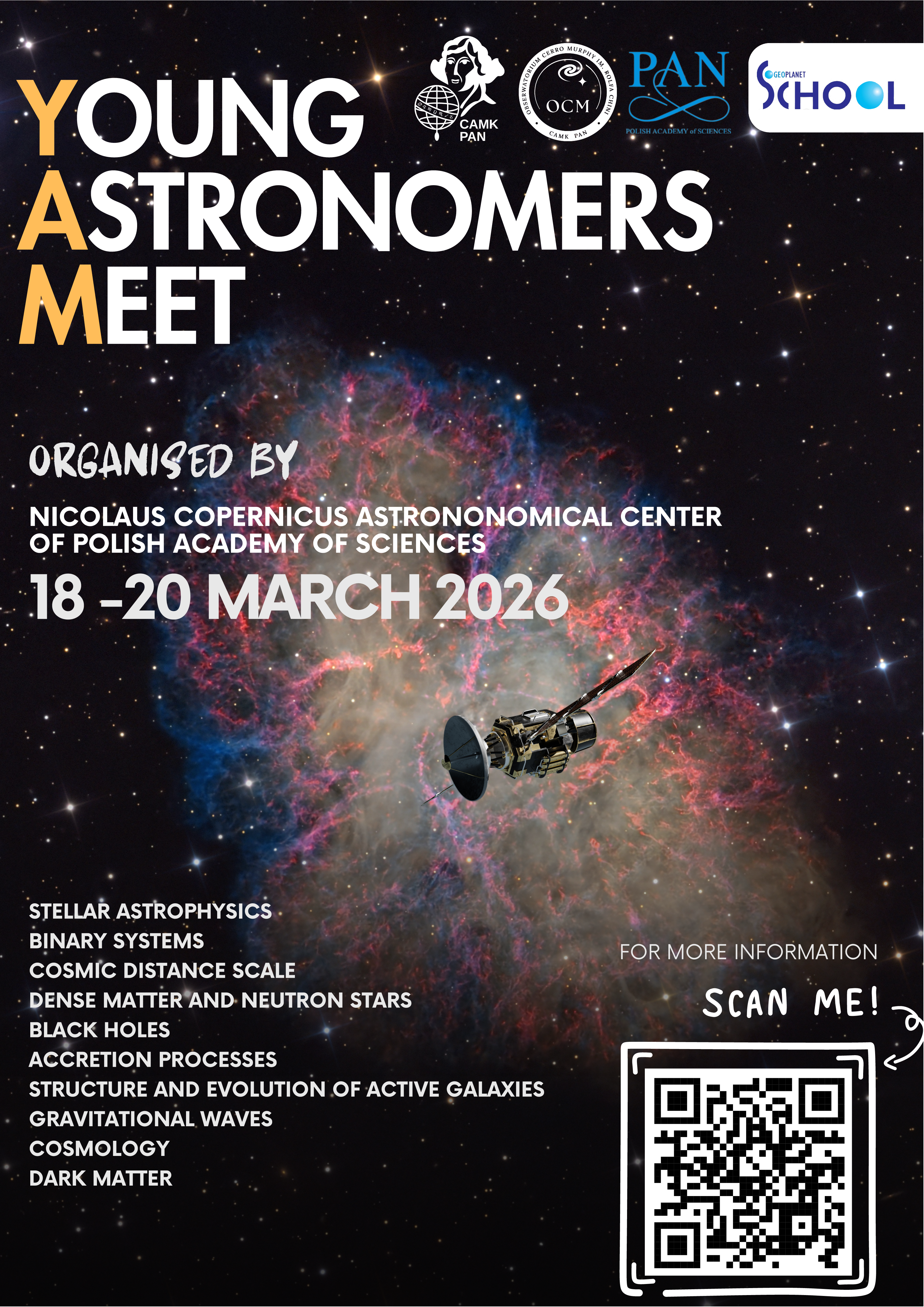
The Young Astronomers Meeting 2026 will be held in hybrid format (both on-site and on the Zoom platform) from March 18th 2026, to March 20th 2026, at the Nicolaus Copernicus Astronomical Center (CAMK PAN).

The goal of the meeting is to familiarise students interested in astronomy with doctoral studies and summer practice opportunities at the Nicolaus Copernicus Astronomical Center (CAMK PAN) (recruitment call is now open, please refer to Doctoral School & Recruitment). This meeting also provides an opportunity for students to present their conducted research in front of a larger audience.

The talks will cover a broad range of topics from astronomy and astrophysics, such as:

  • Stellar astrophysics
  • Binary systems
  • Cosmic distance scale
  • Dense matter and neutron stars
  • Black holes
  • Accretion processes
  • Structure and evolution of active galaxies
  • Gravitational waves
  • Cosmology
  • Dark matter


We invite you to register for this event by 17th March 2026. We also encourage students to submit abstracts for presentation or poster sessions to showcase their research during the meeting. The deadline for the abstract call is 15th March 2026.

There is no participation fee for the event, online or offline. Limited on-site participation slots and limited accommodations for participants who want to join in person from outside of Warsaw.

For any more information, please get in touch with the LOC through email at young.astro.meeting@camk.edu.pl

Participants
    • Registration
      Conveners: Mr Anirudh Nemmani (CAMK), Tanja Kaister (CAMK), Wen Xuan Sia
    • 1
      Welcome address
      Speaker: Wen Xuan Sia
    • 2
      A speech by the director of CAMK
      Speaker: Prof. Rafał Moderski (Centrum Astronomiczne im. M. Kopernika PAN)
    • 3
      GeoPlanet Doctoral School - Recruitment 2026/2027
      Speaker: Dr Radek Smolec
    • 4
      Monitoring X-ray background from high energy particles on the board of NewATHENA mission
      Speaker: Agata Rozanska (CAMK PAN)
    • 10:40
      Coffee break
    • 5
      Models of slim accretion disc around black holes with realistic viscosity prescription
      Speaker: Prof. Marek Abramowicz (CAMK)
    • 6
      Accretion Discs and Outflow Phenomena in Accreting White Dwarf Binaries
      Speaker: Dr Krystian Iłkiewicz (CAMK PAN)
    • 7
      A Multi-Wavelength Exploration of Narrow-Line Seyfert 1 Galaxies
      Speaker: Dr Marzena Sniegowska (CAMK PAN, CFT PAN)
    • 12:00
      Lunch break
    • 8
      X-Ray Data Analysis for AGNs
      Speaker: Parikshit Partha Biswas (Nicolaus Copernicus Astronomical Center, Warszawa)
    • 9
      Novel optical amplification structures for Dark Matter searches
      Speaker: Diego Rodas Rodríguez (Astrocent, CAMK PAN)
    • 10
      The Araucaria Project
      Speaker: Dr Weronika Narloch (Centrum Astronomiczne im. M. Kopernika PAN)
    • 11
      Observatory Cerro Murphy in Chile
      Speaker: Dr Paulina Karczmarek (CAMK PAN)
    • 14:50
      Coffee break
    • 12
      Long-term X-ray spectral variability study of the quasar PDS 456
      Speaker: Fida Fathima S S (Presidency University, Kolkata, India)
    • 13
      Numerical analysis of GRMHD Kelvin-Helmholtz instability
      Speaker: Yauheni Stsefanenka (Astronomical Observatory of the Jagiellonian University)
    • 14
      X-ray variability study of the NLS1 galaxy Ark 564
      Speaker: NIKITA S ARUN (Providence Women's College)
    • 15
      Probing GRB Jet Physics with IceCube Neutrino Non-Detection Upper Limits
      Speaker: Chiranjeet Pradhan (Sardar Vallabhbhai National Institute of Technology (SVNIT) Surat)
    • 16
      General-relativistic magneto-hydro-dynamical simulations of relativistic jets from accreting spinning black holes
      Speaker: Dr Krzysztof Nalewajko (Nicolaus Copernicus Astronomical Center, PAS, Warsaw, Poland)
    • 17
      Numerical and analytical studies of Black Holes, wormholes, and naked singularities
      Speaker: Angelos Karakonstantakis
    • 18
      From Binary Stars to Gravitational Wave Sources and Other Black Hole Populations
      Speaker: Dr Aleksandra Olejak (Max Planck Institute for Astrophysics)
    • 19
      Gravitational Wave Astronomy: A New Frontier in Astrophysics
      Speaker: Dr Sreekanth Harikumar (Nicolaus Copernicus Astronomical Center)
    • 10:20
      Coffee break
    • 20
      Microlensing effect in the long-duration gravitational wave signals
      Speaker: Sudhagar Suyamprakasam (Nicolaus Copernicus Astronomical Center)
    • 21
      Detection of cosmic strings by gravitational wave lensing
      Speaker: Jakub Szyndler (University of Warsaw)
    • 22
      Data analysis of long duration gravitational wave sources
      Speaker: Mr Anirudh Nemmani (CAMK)
    • 23
      How can deep learning help us decipher neutron star composition ?
      Speaker: Valéria Carvalho (Nicolaus Copernicus Astronomical Center)
    • 12:00
      Lunch
    • 24
      Simulating Star Cluster Evolution: From Black Hole Nurseries to Synthetic Observations
      Speaker: Dr Abbas Askar (Nicolaus Copernicus Astronomical Center, Warsaw, Poland)
    • 25
      Development of a Novel Electrostatic Focusing Readout for Large-Scale Hybrid Time Projection Chambers in Neutrinoless Double-Beta Decay Searches
      Speaker: Dr Pedro Silva (AstroCeNT)
    • 26
      Exploring spectral dynamics of Argon scintillation from scintillation, threshold to breakdown voltage in MPGD structures
      Speaker: Dr Pedro Silva (AstroCeNT)
    • 27
      Origin, evolution, and physical properties of Cepheids based on the study of newly detected binary Cepheids
      Speaker: Dr Bogumił Pilecki (Centrum Astronomiczne im. M. Kopernika PAN)
    • 28
      How can we identify galaxies that have stopped forming stars in the early universe?
      Speaker: Sara Alonso Arroyo (International University of Valencia)
    • 14:50
      Coffee break
    • 29
      Dust Attenuation Proxy: A Key Component in Future LSST Data Analysis
      Speaker: Patryk Matera (Narodowe Centrum Badań Jądrowych)
    • 30
      Insights into Hierarchical Star Formation in Nearby Galaxies from UVIT Ultraviolet and Optical Observations
      Speaker: Ananthu Sanal (Indian Institute of Astrophysics)
    • 31
      Accretion flow around fast-spinning compact objects
      Speaker: Sukalpa Kundu (Szkoła Główna Mikołaja Kopernika)
    • 32
      Alignment of spiral and elliptical galaxies with cosmic filaments
      Speaker: Yuvraj Muralichandran (University of Potsdam)
    • 33
      Dark matter’s influence on the evolution of massive binary black holes in dwarf galaxies: a case study of the Leo I dwarf spheroidal
      Speaker: Muhammad Junaid (Institute of Space Technology, Islamabad)
    • 34
      Convective boundary mixing in upper main sequence stars: thermally relaxed magnetohydrodynamic simulations
      Speaker: Arkaprabha Roy (University of Heidelberg, Germany)
    • 35
      MOA-2012-BLG-355: a planetary microlensing event in the vicinity of a variable star
      Speaker: Joanna Pusz (Astronomical Observatory, University of Warsaw)
    • 36
      Stellar mergers: what happens when stars collide?
      Speaker: Thomas Steinmetz (Nicolaus Copernicus Centre for Astronomy)
    • 10:20
      Coffee break
    • 37
      Classical Cepheids in Binary Systems
      Speaker: Felipe Espinoza (CAMK)
    • 38
      Finding the Sweet Spot: Modelling of Oscillating Red Giant Binaries
      Speaker: Inès Amestoy
    • 39
      Stellar age determination using chemical clocks calibrated with detached eclipsing binaries: PART I
      Speaker: Anish Kalsi (NCAC Torun)
    • 40
      Distinguishing Kilonovae from NSBH and BNS Mergers
      Speaker: Mr Yugesh Bhoge (Indian Institute of Technology Bombay)
    • 41
      Life at CAMK Torun
      Speaker: Mr Ganesh N. Pawar (Nicolaus Copernicus Astronomical Center)
    • 42
      Life at CAMK Warsaw
      Speakers: Mr Anirudh Nemmani (CAMK), Wen Xuan Sia
    • 43
      Concluding remarks
      Speaker: Wen Xuan Sia